He who wants to blame sometimes finds the sugar sour.
-German Proverb
Two of my mentors in work and play are Elizabeth Jones and Elizabeth Prescott. In their now out-of-print NAEYC publication, Day Care as a Child-Rearing Environment, they observed:
"The role of the director in implementing flexibility and communication at all levels is crucial. If care of children is to be personal and meaningful, it must also be spontaneous and innovative. If it is both of these, the program will not be smoothly predictable nor predictably beyond criticism. The director not only must take responsibility for the decisions which she makes, but also must constantly communicate her reasons and convictions as to why children's needs are more important than efficiency. Specifically, we feel that she must take major responsibility for initiating communication with parents, and for interpreting and defending (if necessary) policies, practices, and needs to decision makers outside of the center.
"With [his] own staff, [his] role of providing enrichment and simplification of the environment for all staff is not unlike a teacher's responsibilities toward children. Teaching in day care can be monotonous and boring unless balanced by participation in center planning, opportunities for some contact with other adults, and the professional stimulation of visiting other centers and participating in opportunities for in-service training. The director's role of simplification requires a sure administrative hand, which will clear away obstacles to personal solidarity between staff and children."
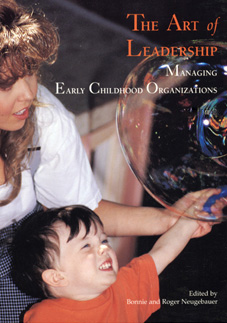
Exchange Press's all-time bestseller, The Art of Leadership: Managing Early Childhood Organizations, serves as an invaluable guidebook for early childhood managers and textbook for early childhood instructors. The comprehensive guide, includes contributions from the leading experts in the field on the following management areas...
- Leadership
- Advocacy
- Getting Organized
- Legal Issues
- Financial Management
- And much more...
 << Previous Issue
| View Past Issues | | Next Issue >>
<< Previous Issue
| View Past Issues | | Next Issue >> 





Comments (3)
Displaying All 3 CommentsSmart Start Early Childhood Learning and Development Center
Charlotte, North carolina, United States
The role of the director is that the director must be well versed in many areas as it relates to mangaing a successful child care business. The director becomes all things to everyone in his or her care. The director wears many hats therefore, he or she must be knowledgeable of all areas such as creating a team as they work together to enhance children and their families, understanding finanancial management, advocating on behalf of children and their families through participation on various organizations and within the community, participating in professional development planning for all staff members, staying abreast on nutrition and creating a healthy environment for all. The role has changed greatly over the years. Directors can not only be competent in the areas of directing their programs but must also be able to articulate the rationale for running a quality program. The textbook, The Art of Leadership Managing Early Childhood Organizations 7th Edition allows potential directors to explore the many options one would have in running a successful child care program.
Lake Fenton Community Schools
Fenton, Michigan, United States
Do you not read what is written before it is printed? It is not now 2011? You would think that the reference of just one gender working with children was something from the past. Maybe I am understanding this wrong and you are saying that women as a director do not take responsibility for the decisions which they “she” makes, and that women are unable to communicate their “her” reasons and convictions as to why children's needs are more important than efficiency? Have you not moved into the 21st century thinking? It is time to take off the blinders and notice that this industry is not just a place for women.
Raymond Gifford
Lake Fenton Community Schools
Kids Klub-Kinder Kare-Preschool Kare
Director
UCLA Early Care and Education
Los Angeles, CA, United States
I LOVE Exchange Everyday and read it every morning before I start my day. I often foward it to people that I thini would like to see that day's article. Today, I was going along happily reading about personal and meaningful, spontaneous and meaningful care of children and the importance of communication. Check.
THEN (flipping to "he") the prescription for keeping "day care teaching" from becoming monotonous and boring lists a few things that can enrich the work life of teachers but misses the thing that truly gets teachers on fire in the classroom. Responsibility for and autonomy in designing and implementing the curriculum for their children will keep teachers from being "bored out" (not "burned out" and will result in better outcomes for children who will then learn from fully engaged teachers. All the other strategies can support this critical function but are not the goal. Teachers need to be able to be excited about being IN the classroom, not excited about the possibility of being OUT of the classroom to training, observations etc. as valuable as those activities are in supporting the implementation of truly exciting early childhood best practices.
Post a Comment