Practice being excited.
-Bill Foster
Here is a problem-solving technique based on child development. We have all connected with a child, who when we answer the question, "Why is the sky blue?" ask "why" over and over again. In "To Get To The Root of A Hard Problem Just Ask 'Why' Five Times" Eric Ries points out that Taiichi Ohno, the father of the Toyota Production System, developed this technique into a systematic problem-solving tool:
"At the root of every seemingly technical problem is a human problem. Five Whys provides an opportunity to discover what that human problem might be. Taiichi Ohno gives the following example:
"When confronted with a problem, have you ever stopped and asked why five times? It is difficult to do even though it sounds easy. For example, suppose a machine stopped functioning:
- Why did the machine stop? (There was an overload and the fuse blew.)
- Why was there an overload? (The bearing was not sufficiently lubricated.)
- Why was it not lubricated sufficiently? (The lubrication pump was not pumping sufficiently.)
- Why was it not pumping sufficiently? (The shaft of the pump was worn and rattling.)
- Why was the shaft worn out? (There was no strainer attached and metal scrap got in.
"Repeating 'why' five times, like this, can help uncover the root problem and correct it. If this procedure were not carried through, one might simply replace the fuse or the pump shaft. In that case, the problem would recur within a few months. The Toyota production system has been built on the practice and evolution of this scientific approach. By asking and answering 'why' five times, we can get to the real cause of the problem, which is often hidden behind more obvious symptoms."
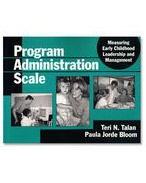 The genesis for the development of the Program Administration Scale (PAS) was the growing consensus that the quality of early childhood programs should be determined by more than just the classroom learning environment. This valuable tool incorporates data obtained through interview or self-report, document review, and observation to reliably measure the administrative practices of an early childhood program. The PAS includes 25 items clustered in 10 subscales, which measure both leadership and management functions of center-based early care and education programs. The PAS can be used in multiple ways: program self-improvement, technical assistance and monitoring, research and evaluation, and public awareness.
 << Previous Issue
| View Past Issues | | Next Issue >>
<< Previous Issue
| View Past Issues | | Next Issue >> 




Comments (3)
Displaying All 3 CommentsUnited States
I think children ask why as an invitation to a discussion, not to be given
an answer or even to solve a
tweety's childcare group home
Chattanooga, Tennessee, United States
This help a lot it make you think I have 5 yrs old and the why never stop
327Matters
United Kingdom
Why is the Sky Blue?
Let’s start by thinking about the Earth and the sky to begin with; Pick up (or draw) a typical jagged rock. This is the planet earth that we live on... Is this how you imagine it? Is this the shape that you have seen in pictures?
The chances are that a child will say that s/he has seen pictures (even if they have been on cartoon programmes) that show it as ‘round’. This might be a good time to take out a globe if you have one - but you should say; ‘That’s right, I’m sorry I just drew the rock part - now I need to draw the stuff that fills in all these cracks and hollow bits and makes the Earth look so smooth and round when you look at it from space’. If you have some blue playdough then you can add it to your rock - otherwise use a blue crayon on your picture to cover most of the ‘rock’ and colour it blue. We can then ask what the blue stuff is called and can agree that that is the ocean and that it is held on to the Earth by ‘gravity’ - which is a force that holds everything down towards the centre of the planet.
Then we can draw another circle outside of that and tell the child that the Earth has another ocean that we live in and that is the ocean of air that we breath - and it is held on in the same way as the ocean of water - by gravity, so it doesn’t drift off into space. We call it the ‘atmosphere’.
You now have the basic building blocks of an answer; the idea that we live in an ocean of air and that, that is what we look up at and call the sky. At night the sky looks black, and that is also the way the ‘sky’ looks from space. What we are actually seeing during the day is a reflection of sun light on a mixture of gases, dust and water vapour (like steam) high up in the atmosphere. The reflection is blue because the light is being scattered by these tiny pieces of dust and water vapour. It’s the same reason that cigarette smoke is blue, you can also demonstrate the effect by putting a drop or two of milk in a glass of water and holding it up to a light. You will find it takes on a blue tint.
Post a Comment